
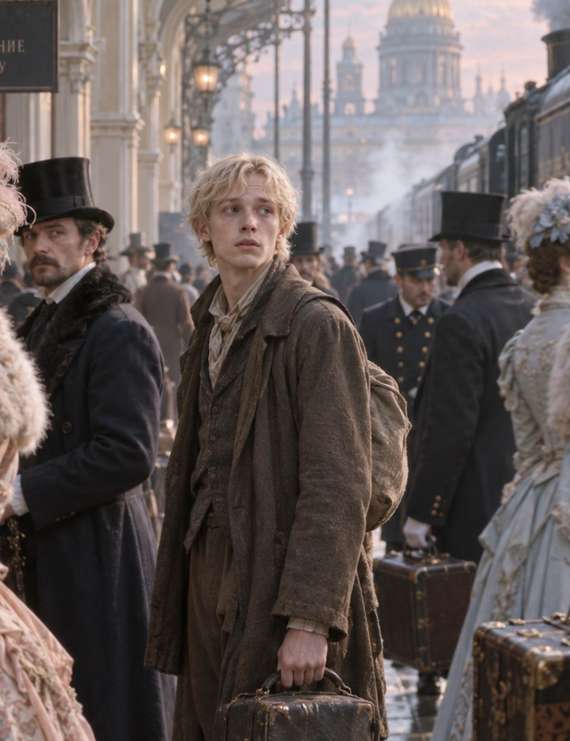
Prince Myshkin steps off a train in St. Petersburg with almost nothing. No money, no scheming, no armor. Just an unusual habit of telling the truth, and an inability to see people as anything less than human.
By the end of the novel, that habit has destroyed him.
Dostoevsky’s The Idiot is often shelved next to Crime and Punishment as “the other big one,” but it asks a very different question. Crime and Punishment asks what guilt does to a man who has done something terrible. The Idiot asks something quieter, and in some ways harder: what happens to a man who has done nothing wrong at all?
A Holy Fool in a Room Full of Wolves
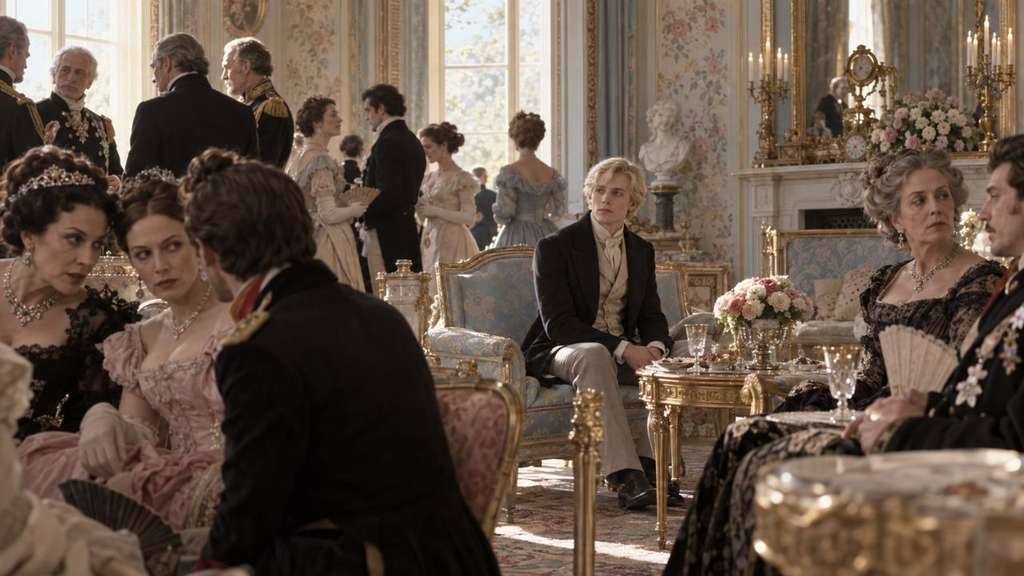
Myshkin is not naive in the way we usually mean it. He understands exactly what people are doing to each other. He watches the greed, the status games, the cruelty dressed up as wit. He just refuses to play along, and refuses to stop caring about the people playing.
This is the tradition of the yurodivy, the “holy fool” in Russian literature and Orthodox culture: someone whose apparent simplicity is really a kind of moral clarity, a willingness to look foolish rather than lie. Dostoevsky puts that figure directly into a drawing room full of Petersburg high society, and watches what happens.
What happens is not redemption. It’s erosion.
Every person Myshkin meets tries to use him for something: his money, his title, his conscience, his silence. And because he refuses to defend himself the way everyone else does, he absorbs the damage that should have gone somewhere else. His honesty isn’t a strength the plot rewards. It’s closer to an exposed nerve.
The Test Dostoevsky Is Running
It helps to read The Idiot less as a story and more as an experiment. Dostoevsky wanted to write, in his own words, a “perfectly beautiful man,” and then find out what a genuinely good person would look like if you dropped him into real, unforgiving social life. Not a saint in a monastery. A man at dinner parties, in love triangles, in rooms where money and reputation are on the line.
The result is uncomfortable, and it’s supposed to be. Goodness, in this book, doesn’t win arguments. It doesn’t fix people. It doesn’t even reliably help the people Myshkin loves most. If anything, his goodness seems to accelerate the tragedy around him, because it gives everyone else permission to lean on him harder.
That’s the real question sitting underneath the plot: is a person like this even compatible with the world as it actually is? Or is “goodness” only survivable when it comes with some capacity for self-protection that Myshkin simply doesn’t have?
Nastasya and Rogozhin: Love as a Collision, Not a Rescue

The emotional center of the book isn’t really Myshkin alone. It’s the triangle between Myshkin, Nastasya Filippovna, and Rogozhin.
Nastasya has been treated as an object her whole life, first by the man who effectively owned her as a mistress, then by every man who circles her afterward, evaluating her like property. Myshkin is the first person who seems to see her as a person rather than a prize or a ruin. But recognition isn’t the same as rescue. Nastasya has been shaped by damage she can’t simply set down, and part of her seems to believe she deserves the destruction that’s coming.
Rogozhin loves her too, but his love is possessive, almost violent in its intensity. It has none of Myshkin’s gentleness and none of his patience. Where Myshkin’s love asks nothing, Rogozhin’s love wants to own.
Dostoevsky doesn’t let one version of love simply defeat the other. He lets them collide, and lets Nastasya be caught between a love that sees her and a love that wants to consume her. That she keeps circling back toward Rogozhin, even knowing what he is, says something bleak about how self-destruction can feel more familiar, and safer, than being truly known.
Myshkin, caught between his feelings for Nastasya and his growing affection for Aglaya Yepanchina, ends up unable to save anyone, including himself.
So, Can Goodness Survive?
Dostoevsky doesn’t give a clean answer, and that’s the point. Myshkin’s story doesn’t end in triumph or in villainy defeated. It ends in collapse: a return to the kind of illness he arrived with at the start of the novel, as if the world has, quite literally, been too much for a mind unwilling to armor itself against it.
That’s a hard note to end on, but it’s also what makes the book stay with you. The Idiot isn’t arguing that goodness is worthless. It’s arguing that goodness, unprotected, is fragile in a way we don’t like to admit. Myshkin doesn’t fail because he’s wrong about people. He fails because being right about people, and loving them anyway, doesn’t come with any guarantee that they’ll be worth it, or that it will be enough to save you both.
It’s worth asking, walking away from this book, whether that’s a flaw in Myshkin, or a flaw in the world he was dropped into.
Watch our full video essay on The Idiot, where we walk through Myshkin’s story scene by scene and dig deeper into what Dostoevsky was really testing.
