For most readers, Bram Stoker begins and ends with Dracula. The novel has so thoroughly shaped the idea of the vampire that it can feel less like a book and more like a cultural inheritance—something absorbed long before it is actually read. In the process, Stoker himself becomes reduced to a single creation, his wider…
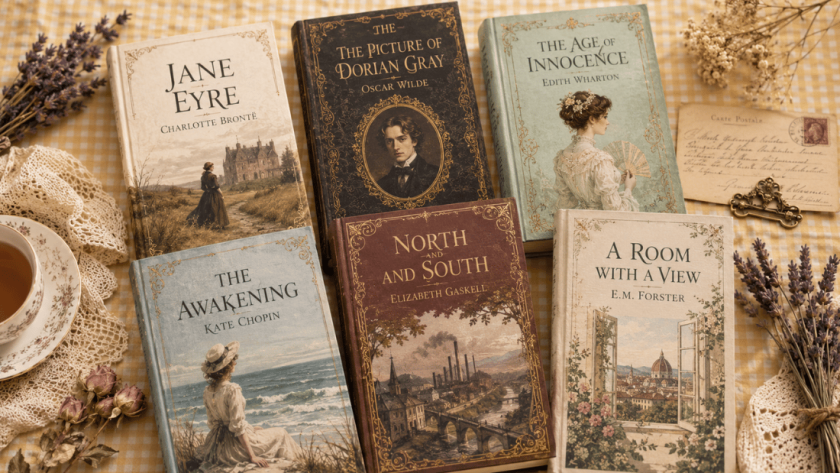
There is a certain kind of reader who wants to get into classics but keeps holding back. Sometimes it is the fear of dense prose. Sometimes it is the memory of being forced through a novel at school before you were ready for it. And sometimes it is simply the assumption that classic books belong…
Classic novels often carry a quiet reputation for being difficult, distant, or even intimidating. Many readers approach them with hesitation, expecting dense language and stories that feel disconnected from modern life. This assumption, while common, is often misleading. The truth is that classic literature is not meant to exclude readers—it invites them into deeper reflection.…
Oscar Wilde is often remembered in fragments. A line quoted out of context. A drawing room filled with laughter. A reputation for brilliance that seems almost too polished to question. Over time, that surface—witty, dazzling, effortlessly clever—can begin to feel like the whole.
But Wilde’s work resists that simplification. Beneath the epigrams lies a writer…
Thomas Hardy’s novels rarely promise comfort. They move through windswept landscapes, small towns governed by custom, and lives shaped as much by circumstance as by choice. Love is rarely simple, ambition often collides with social limits, and the natural world seems to watch silently as human lives bend under expectation, desire, and regret.
Yet Hardy’s…
Imagine walking along cobbled streets while cannons thunder in the distance. Picture yourself standing under golden chandeliers in a royal court or peering down from the rafters of a half‑built cathedral. Historical fiction can take us there. When we open a novel set in another century, the sights, sounds and feelings of the past come…
Jane Austen is often introduced through reputation before experience. Her novels are framed as manners-driven, decorous, even distant—stories one is meant to admire rather than enter. That framing misses the point. Austen wrote with a sharp eye for self-deception, social performance, and the quiet stakes of ordinary lives. Her wit is precise, her sympathy earned,…
For many readers, Louisa May Alcott arrives already defined. Her work is often remembered through a single title, filtered through childhood reading lists and well-worn cultural memory. That familiarity, paradoxically, can create distance—making her feel more like a lesson than a living voice.
Yet Alcott wrote with remarkable emotional attentiveness. Her stories are rooted in…
Few writers dared to capture the inner world like Virginia Woolf. Born in 1882into a family of intellect and privilege, she grew up surrounded by books, conversation, and creativity- but also by the shadow of loss and mental struggle. From those contrasts came one of the most original voices of the 20th century. Woolf turned…
Few authors lived their stories as fiercely as Ernest Hemingway. Born in 1899 in Oak Park, Illinois Hemingway's life was an unending search for purpose- fueled by war, love adventure and loss. He fished in Cuba, hunted in Africa, reported from war zones, and wrote with a simplicity that cut straight to the human heart.…