
Inside Raskolnikov’s Self-Inflicted Prison in Dostoevsky’s Crime and Punishment
Imagine committing the perfect crime. No witnesses, no DNA left behind, no smoking gun linking you to the scene. The police are baffled, and logically, you are entirely in the clear.
You’ve gotten away with murder. Or have you?
In 1866, Fyodor Dostoevsky published Crime and Punishment, effectively inventing the modern psychological thriller by asking that exact question. Unlike standard mystery novels that build toward identifying a killer, Dostoevsky hands us the culprit on a silver platter in the opening chapters. We watch twenty-three-year-old former student Rodion Raskolnikov raise an axe and strike down an elderly pawnbroker, Alyona Ivanovna, and her innocent sister, Lizaveta, in cold blood.
The mystery isn’t who did it. The mystery is whether a human mind can survive the weight of its own dark choices when the rest of the world isn’t looking.
The “Extraordinary Man” Fallacy: Murder as an Intellectual Experiment

Raskolnikov doesn’t kill out of desperation or simple greed. He kills for an idea.
Isolated in his suffocating, closet-sized room in St. Petersburg, he formulates a dangerous theory, published in an academic journal article titled “On Crime.” In it, he argues that humanity is divided into two distinct categories:
- The Ordinary: The vast majority who must obey existing laws, morals, social boundaries, and reproductive duties.
- The Extraordinary: Visionary figures like Napoleon Bonaparte or Julius Caesar—people who have the moral right (and obligation) to step over corpses and break laws if doing so serves a “higher purpose” or advances human progress.
Raskolnikov convinces himself he belongs to the second group. The murder is an experiment to test his own resolve—a twisted rite of passage to prove he is above standard human morality.
“I did not kill a human being, I killed a principle!” — Rodion Raskolnikov
The tragedy—and the core thrill of the novel—is that Raskolnikov’s intellectual arrogance is instantly shattered by his own biology and conscience. The second the act is finished, his body rejects the theory. He collapses into a delirious fever, torn apart by paranoia, panic, and an overwhelming isolation from the rest of humanity. In trying to prove he was a giant capable of reshaping the world, he discovers he is fragile, terrified, and deeply human.
St. Petersburg as a Character: The City of Fever and Decay
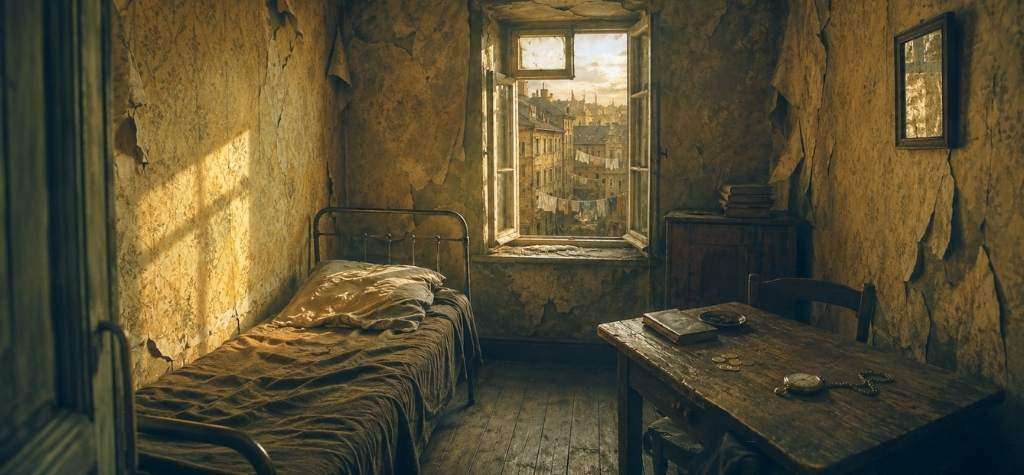
Dostoevsky does not set this story in a romanticized, imperial St. Petersburg of palaces and ballrooms. Instead, the city itself operates as an active accomplice and a physical representation of Raskolnikov’s decaying psyche.
The setting is suffocating, filthy, and intensely oppressive:
- The Cramped Rooms: Raskolnikov’s apartment is repeatedly described as a “cupboard” or a “coffin.” The ceiling is so low that a tall man fears bumping his head, symbolizing how his extreme isolation and physical confinement distort his thoughts into monstrous shapes.
- The Yellow Aesthetic: Dostoevsky saturates the novel with the color yellow—the faded yellow wallpaper in Raskolnikov’s room, the yellow face of the pawned items, the yellow water served to prisoners, and the jaundiced skin of the city’s destitute. Yellow becomes the visual signature of moral and physical sickness.
- The Sweltering Heat: The story takes place during a brutal summer heatwave. The dust, lime, stench of taverns, and crowded streets create a claustrophobic pressure cooker that drives characters toward emotional outbursts, hallucinations, and erratic decisions.
St. Petersburg is not merely a backdrop; it is a landscape of fever. The city mirrors the rotting moral state of its inhabitants, showing how an environment stripped of beauty, air, and dignity feeds ideological madness.
The Psychological Chess Match: Porfiry Petrovich vs. Raskolnikov
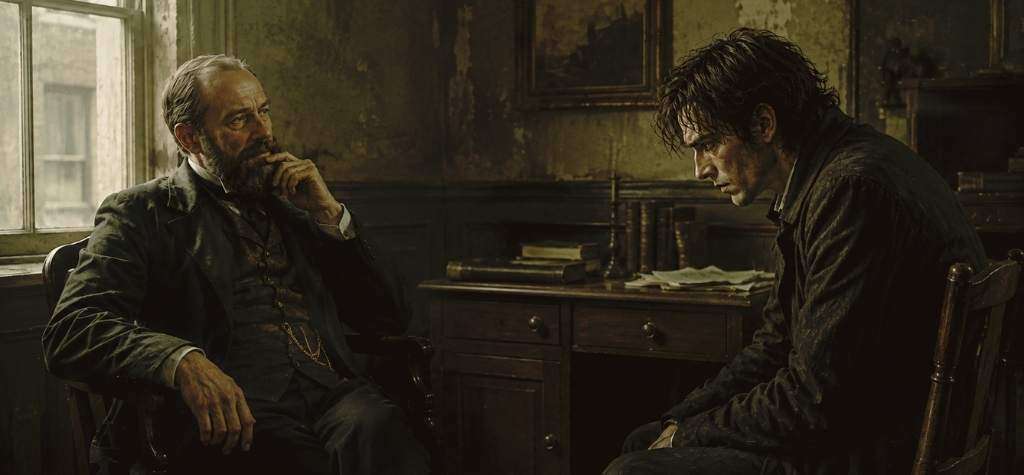
What makes Crime and Punishment so chilling is that physical force and traditional police work are almost irrelevant. Enter Porfiry Petrovich, the lead investigator assigned to the pawnbroker’s murder. Porfiry represents the birthplace of modern psychological profiling, laying the foundation for iconic pop-culture detectives like Columbo.
Porfiry knows Raskolnikov is the killer almost from their first meeting, but he has no hard evidence. Instead of making an immediate arrest, he plays a masterclass game of psychological cat-and-mouse across three pivotal interviews:
  [ Interview 1: Intellectual Trap ] ──> Porfiry cites Raskolnikov's article on "Extraordinary Men."
             │
             ▼
  [ Interview 2: Verbal Maneuvers ]  ──> Porfiry plays harmless; Raskolnikov's paranoia spikes.
             │
             ▼
  [ Interview 3: Open Confrontation ] ──> Porfiry drops the mask: "It was you, Rodion Romanovitch."
- The Intellectual Trap: In their first conversation, Porfiry subtly brings up Raskolnikov’s essay on the “Extraordinary Man.” By engaging Raskolnikov on an intellectual level, Porfiry coaxes the killer into passionately defending the very logic that motivated the murder.
- The Weapon of Silence and Irrelevance: Porfiry speaks in rambling, indirect anecdotes, acting like a bumbling bureaucrat. This infuriates Raskolnikov, who wants a formal accusation so he can defend himself. Porfiry understands that a guilty conscience hates silence and uncertainty; left without direct evidence to fight, the suspect will eventually talk just to fill the agonizing void.
- The Trap of Free Will: Porfiry explicitly tells Raskolnikov that he won’t lock him up yet, because if a suspect is allowed to walk free with a heavy secret, they will orbit the crime scene and the investigator like a moth around a candle.
“Have you ever seen a butterfly near a candle? Well, he will keep circling round me, circling round me… he’ll keep making circles, narrowing the radius, and—pop! He’ll fly straight into my mouth!” — Porfiry Petrovich
Porfiry’s genius lies in recognizing that the human mind cannot tolerate unexpressed guilt. The investigator doesn’t trap the criminal; he simply provides the room for the criminal to trap himself.
Pivotal Scenes: The Cracks in Raskolnikov’s Shield
Beyond the murder itself, Dostoevsky builds the narrative around a series of emotionally charged set pieces that expose the conflict raging within Raskolnikov’s soul.
1. The Dream of the Mare (Foreshadowing)
Before the murder ever takes place, Raskolnikov has a horrific nightmare about a group of drunk peasants beating a small, weak mare to death because it cannot pull a heavy wooden wagon. In the dream, young Raskolnikov runs to the dying horse, throwing his arms around its bleeding head in tears. This dream lays bare his true nature: despite his attempts to play the cold, calculating murderer, his core self is deeply compassionate and revulsed by cruelty. The axe strike against the pawnbroker is a strike against his own innate empathy.
2. The Tragedy of the Marmeladovs (Social Critique)
Raskolnikov’s encounters with Semyon Marmeladov—a ruined, alcoholic former civil servant—and his starving family highlight the brutal realities of poverty in 19th-century Russia. Marmeladov’s daughter, Sonya, is forced into prostitution to buy bread for her stepchildren. This storyline serves a dual purpose: it critiques a heartless socio-economic system and introduces Sonya, whose willingness to suffer for others acts as the ultimate moral antidote to Raskolnikov’s selfish ideology.
3. The Reading of Lazarus (The Turning Point)
In one of the most famous scenes in world literature, Raskolnikov visits Sonya in her meager room. He demands that she read aloud the biblical story of the raising of Lazarus from the dead. The scene features a murderer and a prostitute huddled over a candle, reading a story of resurrection. It marks the moment Raskolnikov realizes that intellectual logic offers no salvation; spiritual rebirth requires acknowledging his own deadened state and opening himself to love and suffering.
Two Paths to the Soul: Sonya vs. Svidrigailov
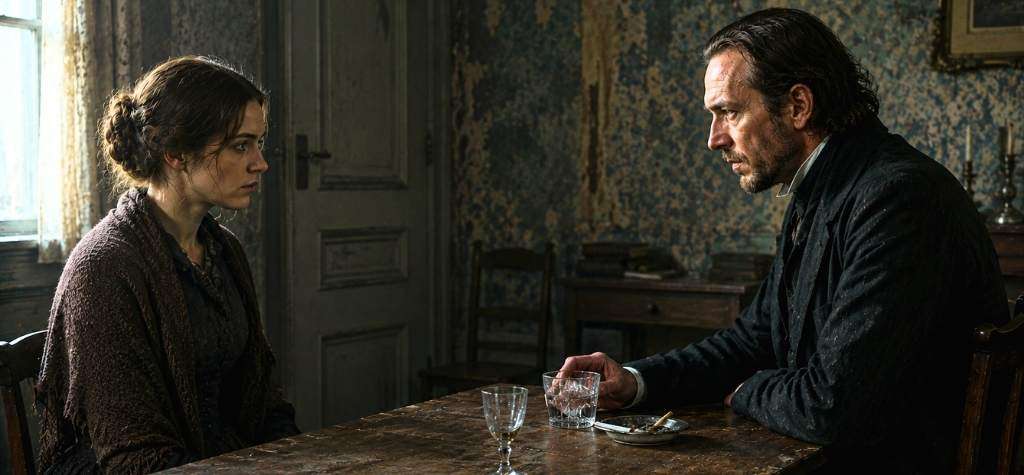
To emphasize Raskolnikov’s internal crisis, Dostoevsky surrounds him with two dark mirrors—characters who represent the ultimate outcomes of his soul’s struggle:
| Character | Representation | Outcome for Raskolnikov |
| Sonya Marmeladova | Selfless love, spiritual humility, and unconditional acceptance. | The path to confession, suffering, and ultimate redemption. |
| Arkady Svidrigailov | Pure nihilism, total rejection of morality, and absolute self-gratification. | The path to madness, emptiness, and eventual self-destruction. |
Svidrigailov shows Raskolnikov what happens when a person successfully numbs their conscience: life becomes a vacant, meaningless void. When Svidrigailov realizes he is completely incapable of genuine love, he commits suicide, showing that total moral detachment leads to literal death. Sonya, on the other hand, demonstrates that true strength isn’t standing above morality like Napoleon, but having the courage to carry one’s own cross, accept accountability, and seek forgiveness.
The Father of the Modern Anti-Hero: From Raskolnikov to Prestige TV
It is impossible to understand modern pop culture without recognizing Raskolnikov’s spiritual descendants. Dostoevsky drafted the archetype of the brilliant, morally compromised protagonist who rationalizes horrific actions under the banner of a personal crusade or intellectual superiority.
Look at how Raskolnikov’s DNA manifests in modern media:
- Walter White (Breaking Bad): Walter continually claims he enters the drug trade “for his family.” Much like Raskolnikov’s “Extraordinary Man” theory, Walter’s noble excuse masks a deep-seated ego and a desire to prove his own intellectual dominance over a world that overlooked him.
- Joe Goldberg (You): Joe commits stalking and murder while delivering long, internal monologues that frame his crimes as acts of protection or tragic necessity. He operates on his own internal ethical code, continuously convincing himself he is a “good guy” trapped in bad circumstances.
- Light Yagami (Death Note): Light uses a supernatural notebook to murder criminals, explicitly declaring himself a god who will cleanse the world. Light is the literal realization of Raskolnikov’s Napoleon theory—an extraordinary individual who believes he sits above human law for the greater good.
Dostoevsky was the first to show us the terrifying intimacy of spending time inside a killer’s internal monologue. By forcing the reader to walk in lockstep with Raskolnikov’s rationalizations, he made us complicit in his mind games, establishing the formula for modern prestige television and psychological thrillers.
Watch the full breakdown here!
We made a full video essay walking through Raskolnikov’s theory, the murder, and the slow unraveling that follows — including the parts of the story we couldn’t fit into this article. If you want the deeper dive, it’s below.
Crime and Punishment YouTube link
If you enjoyed this, subscribe to AmpleReads on YouTube for more classic literature, broken down the way it was always meant to be understood — no lecture hall required.
Conclusion: The Moral Architecture of Conscience
Dostoevsky’s answer to our central question—Can you really get away with murder if no one catches you?—is an absolute, uncompromising No.
The legal system might fail, the evidence might vanish, and the police might remain clueless. But human nature contains its own internal tribunal. You cannot hide from a witness who lives inside your own head.
Crime and Punishment remains a timeless masterpiece because it reminds us of a fundamental boundary: you can rationalize anything in your intellect, but you cannot rewrite the moral architecture of your conscience. In the end, Raskolnikov’s true punishment wasn’t the hard labor sentence handed down in Siberia. It was the agonizing realization that in trying to prove he was a giant, he had crushed his own humanity—and that true freedom only begins when the ego surrenders to truth.
